
Dubai sits on the edge of the Arabian Gulf, one of the world's warmest, most accessible bodies of water, making it an exceptional base for aquatic fitness pursuits. Freediving (breath-hold diving) and scuba diving have both found enthusiastic communities in the emirate, with a growing ecosystem of dive centres, certified instructors, and dedicated pools offering year-round training regardless of whether you want to explore underwater worlds or harness the extraordinary physiological benefits of breath training for broader athletic performance.
This guide covers both disciplines: the meditative, minimalist world of freediving and the equipment-assisted exploration of scuba diving, exploring their distinct fitness applications, where to train in and around Dubai, costs, certifications, and why breath-hold training specifically is attracting increasing attention from elite athletes, yoga practitioners, and wellness-focused individuals.
Freediving: The Mind-Body Sport Gaining Momentum in Dubai
Freediving, diving on a single breath without a scuba tank, is one of the world's oldest human activities, historically used for pearl diving throughout the Arabian Gulf for centuries. The UAE has a deep cultural connection to breath-hold diving through its pearl diving heritage, and modern competitive and recreational freediving has grown significantly in the region over the past decade.
Contemporary freediving is practised as both a sport (with competition categories including static apnea, dynamic apnea, and constant weight depth) and a wellness practice (for its extraordinary effects on the nervous system, breathing efficiency, and mental composure). Many Dubai-based athletes from other sports have incorporated freediving breath training into their programmes after discovering its transferable benefits.
The Unique Fitness Benefits of Freediving
Freediving develops physiological adaptations that few other sports can replicate.
Breath control and CO2 tolerance: Freediving systematically trains your body's response to rising CO2 levels, the primary trigger for the urge to breathe. Practitioners develop the ability to remain relaxed under significant physiological stress, a skill that transfers directly to athletic performance across virtually all sports. Distance runners, cyclists, and team sport athletes who incorporate breath training consistently report improved performance under exertion.
The mammalian diving reflex: When submerged in water, the human body activates an ancestral reflex that slows heart rate (bradycardia), redirects blood from extremities to vital organs, and improves oxygen efficiency. Regular diving stimulates this reflex, training the cardiovascular system in ways conventional exercise cannot. Regular freedivers develop resting heart rates comparable to endurance athletes as a side effect of breath training.
Diaphragm and respiratory muscle strength: Freediving's full inhalation (packing) and controlled exhalation techniques develop the diaphragm, intercostal muscles, and accessory breathing muscles to a degree unmatched by any other practice. This has direct benefits for lung capacity, athletic breathing efficiency, and posture.
Mental composure under pressure: Staying relaxed while your body is screaming to breathe is the defining challenge of freediving. Practitioners develop extraordinary mental resilience, the ability to distinguish genuine emergency signals from discomfort, and the capacity to perform precisely under intense physiological stress. These skills transfer directly to competitive sport and high-pressure professional environments.
Full-body aquatic fitness: The finning technique used in freediving (typically long-blade monofin or bi-fin dolphin kick) develops exceptional hip flexor, glute, hamstring, and core strength. An active freediving session burns 300 to 500 calories per hour, less intense than terrestrial sports but sustained over long sessions and combined with the significant metabolic cost of thermal regulation in water.
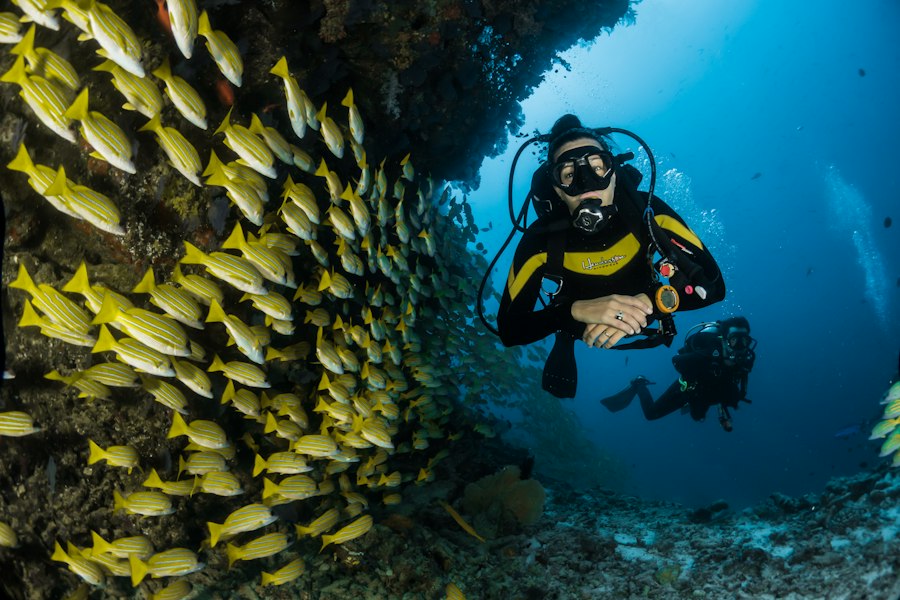
Scuba Diving as a Fitness Activity in Dubai
While scuba diving is not conventionally classified as a high-intensity workout, it offers significant and often underappreciated fitness benefits, particularly for mental wellness and low-impact full-body conditioning.
The buoyancy of water reduces joint stress while the need to maintain controlled finning, trim position, and current resistance provides meaningful muscular demand on the legs, core, and stabilising muscles throughout the dive. A 45 to 60 minute dive burns 300 to 600 calories depending on water temperature, current strength, and the diver's exertion level. Cold water significantly increases caloric expenditure as the body thermally compensates.
The mental wellness benefits of scuba diving are substantial and well-documented. The focused, meditative state of being underwater, surrounded by marine life, with only the sound of your own breathing, produces measurable reductions in cortisol (stress hormone) levels. Many Dubai-based professionals report that regular diving is their most effective stress management tool. Research published in sports psychology journals confirms significant improvements in mood, anxiety levels, and sleep quality among regular divers.
Dubai's Diving Environment: What to Expect
The Arabian Gulf off Dubai's coast offers accessible, warm-water diving suitable for beginners and intermediates. Water temperature ranges from 20°C in January to 34°C in August, eliminating the wetsuit requirement for much of the year. Visibility is typically 5 to 10 metres in the Gulf, not comparable to the Red Sea or Indian Ocean, but sufficient for enjoyable recreational diving.
Dubai's notable dive sites include the MV Dara wreck (a significant historical wreck), the Cement Barge, and various artificial reef structures. Marine life includes diverse reef fish, rays, seahorses, octopus, and occasionally whale sharks and barracuda in season.
For those willing to travel 90 minutes from Dubai to Fujairah on the East Coast, the Gulf of Oman offers dramatically better conditions: visibility of 10 to 25 metres, richer marine biodiversity, and famous sites including Dibba Rock, Snoopy Island, Martini Rock, and the Lima Rock shark aggregation sites. Most Dubai-based dive centres organise regular East Coast day trips and weekend packages.
- Arabian Gulf (Dubai side): Visibility 5 to 10m, temp 20 to 34°C, good for beginners
- Gulf of Oman (Fujairah, 90 min): Visibility 10 to 25m, richer marine life, better for sport diving
- Best diving season: October May (ideal visibility and temperature)
- Summer diving: Possible but visibility reduced; hot surface conditions
- Pool training: Available year-round at multiple Dubai centres
Freediving Certification in Dubai, AIDA Courses
The primary freediving certification body globally is AIDA International (Association Internationale pour le Développement de l'Apnée). Several Dubai and Fujairah-based centres offer full AIDA certification pathways.
AIDA 1, Introduction
Pool-based theory and breath-hold introduction. No prerequisites. Half or full day.
AIDA 2, Freediver
Static apnea 90s, dynamic 40m, depth 16m. 2 to 3 days. Most popular entry level.
AIDA 3, Advanced Freediver
Static 2:30, dynamic 70m, depth 24m. Requires AIDA 2 certification. 3 to 4 days.
AIDA 4, Master Freediver
Performance level for serious practitioners. Static 3:30, depth 32m+.
Freediving courses in Dubai are typically conducted at training pools for confined water sessions and at East Coast locations (Fujairah) for open water qualifying dives. The AIDA certification cards issued are globally recognised and required for diving with dive centres worldwide at deeper than recreational snorkelling depths.
Find Aquatic Fitness Coaches in Dubai
Browse swimming coaches, aqua fitness instructors, and wellness professionals on GetFitDXB. Book a trial session with a verified instructor today.
Scuba Diving Certification in Dubai, PADI Courses
PADI (Professional Association of Diving Instructors) is the world's largest scuba training organisation and the dominant certification system in Dubai. All major Dubai dive centres are PADI accredited, ensuring consistent quality and globally recognised qualifications.
- PADI Discover Scuba Diving (DSD):, no certification, supervised introductory dives in pool and/or shallow open water. Perfect for testing scuba before committing to a full course.
- PADI Open Water Diver:, the fundamental scuba certification. 3 to 4 days including knowledge development, confined water (pool) skills, and 4 open water dives to 18m max. Globally recognised, valid for life.
- PADI Advanced Open Water:, 5 specialty dives (deep, navigation + 3 electives) extending limit to 30m. Typically taken after 10+ logged dives.
- PADI Rescue Diver:, significant confidence and safety skill-building course. Highly recommended before pursuing dive leadership.
- PADI Divemaster:, professional-level qualification to guide certified divers. 3 to 6 months internship typically required.
Breath Training for Non-Divers: The Land-Based Application
You do not need to get in the water to benefit from freediving breath training principles. Dubai's wellness community has increasingly adopted structured breath-hold and CO2 tolerance training as a cross-disciplinary tool for athletes, yoga practitioners, and executives managing performance under pressure.
Dry static apnea training (breath-holds on land, supine) is practised by free divers between pool sessions and can be adapted safely for non-divers with proper guidance. CO2 tolerance tables (structured breath-hold protocols with progressively shorter recovery intervals) have been demonstrated to improve athletic performance in cyclists, runners, and team sport athletes by training the body to perform more efficiently under elevated CO2 conditions.
The connection to other Dubai wellness practices is significant. Practitioners of Wim Hof breathwork and breathwork classes share foundational principles with freediving, the emphasis on controlled breath patterns, physiological self-awareness, and performing calmly under stress. Several Dubai breath coaches have backgrounds in competitive freediving.
Fitness Preparation for Freediving and Scuba
While neither discipline requires exceptional pre-existing fitness, targeted preparation enhances both safety and enjoyment.
For freediving, the most relevant fitness investments are: breath-hold conditioning (CO2 tolerance tables and O2 tables), flexibility (particularly thoracic and diaphragm mobility for packing techniques), and swimming fitness (200 to 400m continuous efficient swimming). Pool swimming is the most directly applicable land-to-water preparation. Yoga, particularly pranayama breathwork, is highly valued by serious freedivers for its breathing control and body awareness benefits.
For scuba diving, cardiovascular fitness improves air consumption (the most practically important performance metric for recreational divers, fitter divers last longer). Swimming ability provides a safety margin and reduces anxiety underwater. Core stability improves buoyancy control and reduces the fin-kicking effort needed to maintain position.
Equipment Guide: What You Need to Start
Freediving Equipment
- Wetsuit (2 to 3mm):, adequate for Arabian Gulf year-round (except January February when 5mm may be preferred)
- Low-volume mask:, critical for freediving; standard scuba masks require too much equalisation volume
- Long-blade fins (bi-fins):, carbon fibre blades for advanced practitioners
- Monofin:, for dynamic apnea specialists
- Weight belt and weights:
- Safety lanyard (dive buoy):, essential for open water training
Scuba Equipment (for own-kit divers)
- BCD (buoyancy control device):
- Regulator:
- Wetsuit:
- Mask, fins, snorkel:
Most Dubai dive centres provide all equipment for course and guided dives, so personal equipment investment can be deferred until you are certain about committing to the sport. Equipment rental is typically included in course fees.
Costs Summary: Diving in Dubai (2026)
- Discover Scuba (introductory):
- PADI Open Water certification:
- AIDA 2 Freediver certification:
- Guided fun dive (1 dive, equipment included):
- East Coast day trip (Fujairah, 2 dives):
- Pool freediving training session:
- Private freediving coaching session:
Dubai-based dive operators typically run day trips to Fujairah's East Coast on weekends (Friday Saturday), departing early morning and returning in the evening. These trips represent excellent value for experienced divers wanting regular ocean time without travelling abroad.
The Wellness Dimension: Diving and Mental Health
The mental health benefits of regular diving are among the most compelling reasons Dubai's professional community has embraced the sport. The underwater environment demands complete presence, you cannot respond to messages, ruminate on work problems, or be distracted by anything outside the immediate sensory experience. This enforced mindfulness produces genuine psychological restoration that many divers describe as unmatched by any other activity.
The breath-focus required in freediving in particular produces physiological states similar to deep meditation, parasympathetic nervous system activation, slowed heart rate, and elevated body awareness. Many practitioners who also do yoga and breathwork find freediving to be the deepest experience of these principles in practice.
For Dubai's stress management toolkit, regular diving offers something that gym training, yoga, and conventional exercise cannot fully replicate: total environmental immersion that forces the mind offline. This is a powerful complement to more conventional fitness practices and deserves consideration by anyone managing high-pressure professional demands.
Are You a Dive Instructor or Aquatic Coach in Dubai?
List your freediving courses, scuba instruction, and aquatic coaching services on GetFitDXB. Reach thousands of Dubai residents exploring water sports.
AIDA 2 course cost
PADI OW course cost
Water temp range20 to 34°C
Gulf visibility5 to 10m
Fujairah visibility10 to 25m
Calories/60-min dive300 to 600 kcal
Related Articles
Browse on GetFitDXB
Useful Guides
Frequently Asked Questions
Can you freedive in Dubai?
Yes, Dubai and the wider UAE offer accessible freediving. The Arabian Gulf provides warm (20 to 34°C), calm water year-round. Several AIDA-certified centres operate in Dubai and Fujairah. The East Coast (90 minutes away) offers deeper, clearer water ideal for depth training at famous sites like Dibba Rock.
How much does a PADI Open Water course cost?
PADI Open Water certification in Dubai typically including pool sessions, open water dives, and certification materials. Fujairah-based operators may offer slightly lower prices. AIDA 2 Freediver courses run
What fitness level is required for freediving?
Recreational freediving does not require exceptional fitness. The ability to swim comfortably for 200m and reasonable breath awareness are the primary prerequisites. Medical clearance is required for heart or respiratory conditions. Competitive depth freediving demands more specific conditioning, but recreational AIDA 1 to 2 courses start from a very accessible baseline.
Where is the best diving near Dubai?
Fujairah on the UAE's East Coast (90 minutes from Dubai) offers the best conditions, visibility 10 to 25m, richer marine life, and famous sites like Dibba Rock, Snoopy Island, and Martini Rock. Dubai itself has wreck dives and reef dives accessible within the emirate.
Is freediving dangerous?
Freediving carries real risks (shallow water blackout) but these are effectively managed through certified training, the buddy system, and following established protocols. AIDA courses place strong emphasis on safety procedures. Freediving should always be done with a trained buddy, never alone. With proper training, recreational freediving is a safe activity enjoyed by millions worldwide.